The debugger, brought back to life
Demonia carries a whole machine-code monitor inside it — a debugger, written by Claude Sablatou for Loriciels in 1984, riding along in the 1986 game because the same man wrote both. The Findings page tells how it was found and why, on this tape, it no longer answers: the game recorded its 24 screen records straight over the monitor's own data section (0xD000-0xD8FF), erasing its command table, its disassembler tables and about a dozen of its screen and keyboard subroutines.
This page is about putting it back on its feet — and it works.
To be clear from the start: this is not the original debugger recovered whole. We do not have 100% of Sablatou's code. About 40% of the monitor — the data and routines the game erased — no longer exists anywhere and had to be rebuilt. What runs is roughly 60% his surviving original code and 40% reconstructed to match it: a working equivalent, not the lost original.
What survived, and what did not
Sixty per cent of the monitor is intact: its command interpreter, its single-step, its register dump, its disassembler code, and all its text, live on untouched from 0xC24D to 0xCFFF and 0xD900 to 0xDAC7. What the game destroyed was its data, in 0xD000-0xD8FF:
| lost piece | what it was |
|---|---|
command table (0xD5C6) | 15 entries of initial letter + handler pointer |
disassembler tables (0xD64A, 0xD67C, 0xD826, 0xD88B, 0xD5F3…) | ~2 KB: mnemonics, opcode maps, operand-format pointers |
screen/keyboard subroutines (0xD200-0xD2E8) | clear, new-line, wait-a-key… |
This is a reconstruction, not a recovery. Sablatou's original bytes for those tables and routines are gone for good. What follows is a functional equivalent: new code and data that fulfil the exact same contracts the surviving code expects, so that his surviving code runs again and the monitor behaves as it did.
Bringing back the interactive monitor
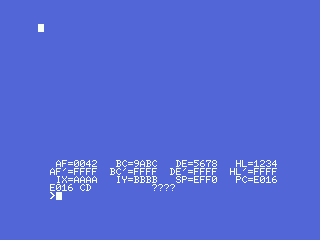
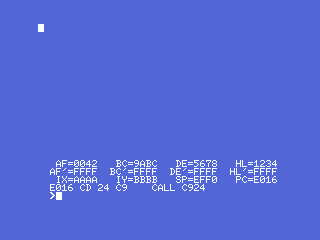
The dead zone took a dozen of the monitor's own screen and keyboard subroutines with it (0xD200-0xD2E8). Each is rebuilt at its exact address from the contract its surviving callers demand: 0x0072/INITXT for the 40-column text screen (proven by its own cell geometry, row*40 + col + 2), a non-blocking key read over CHSNS/CHGET, the pair that swap the slot layout between the monitor's memory and the stopped program's, the beep on a bad command, and the BASIC error hook. With those in place the monitor boots, sets up its screen, and paints the twelve registers of the stopped program — the picture at the top of this page, where HL=1234, DE=5678, IX=AAAA are the values a small launcher put there on purpose.
The command table is rebuilt entry by entry, each surviving handler given back its letter, and every command answers — typed for real into the monitor and read back off the screen on a Philips VG-8020:
| key | command | what it does |
|---|---|---|
L | list | disassembles a range of memory |
D | dump | shows memory as hex and ASCII, and edits it under a cursor |
S | search | hunts for a byte from an address and lands on it |
R | registers | prints the twelve of the stopped program |
F | flags | spells out SZ1H1PNC for it |
I | interrupts | allowed or forbidden on the way back |
B | breakpoints | lists the ten slots |
T | trace | single-steps the stopped program |
= | evaluate | reads a number in any base and prints it |
G | go | restores the registers and jumps |
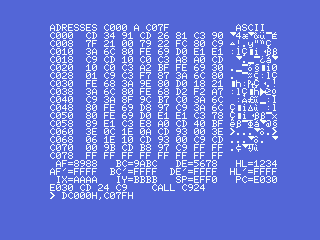
D is the debugger's workbench: a screen of memory in hex and ASCII, a cursor you drive with the arrows, and hex digits that overwrite the byte under it —
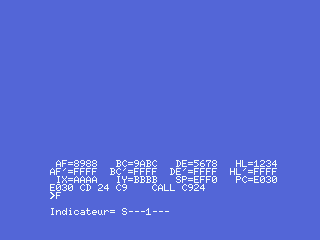
F reads the flag byte straight off the stopped program — here S---1---, the sign flag and the ever-set bit of an AF whose low byte is 0x88:
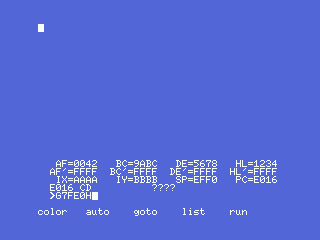
G — Go, and the fossil. The handler at 0xC5D3 parses a hex address, stores it and jumps there. The fossil left the last thing the author ever typed, G7FE0, frozen in the input buffer. Typing that exact command back into the resurrected monitor jumps to the sound routine at 0x7FE0 — his 1986 debugging session, replayed by hand:
T — trace is the single-step. It disassembles the next instruction, copies it into a scratch buffer, runs it with the program's own registers, and takes control back to redraw them advanced by one. It is the command that needs the disassembler to tag each instruction by kind — a jump, a call, a return — so the step knows how to resume, and it does: tracing a short loop marches the program counter and the registers forward one instruction at a time.
One thing the monitor can no longer do in full: the = calculator reads and converts a value in any base, but its operator table lived at 0xD8FB, inside the dead zone, so chained arithmetic (+, -, *, /) went with it — one more small casualty of the overwrite, stated plainly.
The disassembler
The disassembler was the hard part. Its tables were the most thoroughly erased, and the routines that formatted its operands lived in the dead zone too. So the disassembler is the most complete equivalent: a compact Z80 disassembler that fulfils the monitor's contract — given an address in IX, it writes the mnemonic text and the instruction length exactly where the surviving display code (0xC568) expects them. Only that one call had to be repointed.
It covers the whole Z80 instruction set — unprefixed, CB, ED, DD/FD (IX/IY) and DDCB/FDCB — and it was checked instruction by instruction in the emulator, group by group: relative-jump targets, (IX+d) and (IY-d) displacements, the DD CB bit operations and every instruction length. The register dump already proves it on screen — the line under the registers reads the instruction at the program counter:
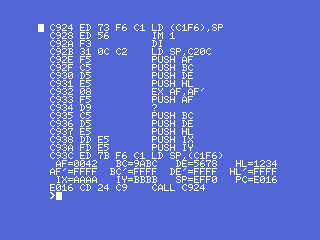
And with the L (list) command wired to its surviving handler at 0xC535, the monitor will disassemble any range. The finest proof there is: the monitor disassembling its own machine code, its entry routine, live on screen — LD (C1F6),SP, IM 1, the register-saving PUSH sequence, LD SP,(C1F6):
How to read it, and how it was built
Numbers use the Intel/Loriciels convention the parser expects: a hex address carries a trailing H (L7FE0H,7FE6H). The reconstruction lives in the repository under debugger/: the disassembler generator (gen_disasm.py), the rebuilt helpers and command table, and the openMSX scripts that boot the monitor and captured every screenshot on this page on a real MSX1 (a Philips VG-8020). Nothing here is a mock-up; every picture is a raw frame from the emulator running the reconstructed monitor.
Careful with the claim: what is measured is that the reconstructed monitor boots, accepts every command and disassembles correctly, shown by the captures and an instruction-by-instruction check of the disassembler. What is a reconstruction — stated plainly — is the command table's letters, the rebuilt helper routines and the disassembler itself; those are equivalents, not Sablatou's lost originals, and one lost table (the = operators) is gone for good.