Curiosities
The bugs
A high score ten points higher than the game
When the train enters a square with no way out, it is first given the 10
points of the new square and then it crashes. The game loop paints the score
(pinta_puntos, 0x056B) and right after that checks the high score
(mira_record, 0x056E); if the interrupt falls between the two, the high
score gets those 10 points and the player's score does not, because after the
crash it is not painted again. On the last train, it stays like that for good:

Measured in the empuja.tcl recording: on frame 2057 the RAM holds 290
points and a 290 high score, and the screen, 280 and 290.
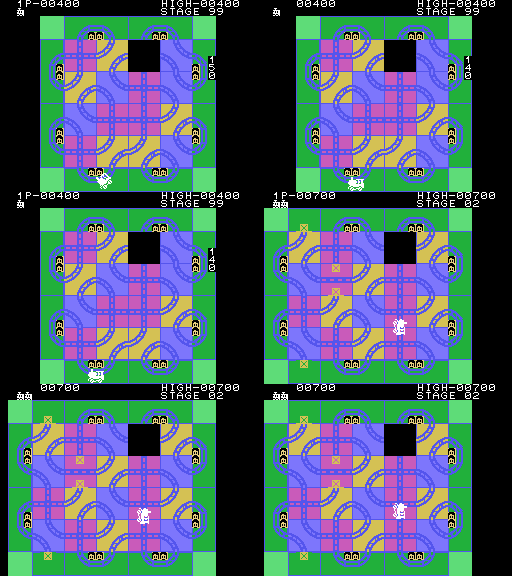
After stage 99, stage 02
When a stage starts its number goes up by one, in BCD; if it goes from 99 to
00, the program puts 2 (0x032C). Tried in openMSX with the stage set to 98
(fase99.tcl): STAGE 99 and then STAGE 02.
The demo runs off its strip
The demo takes one push per square from a strip of 16 (0x13E2) without checking where it ends: if the train lasts longer, it reads the title text as if it were pushes. In one of the recorded demos it got to square 24 (0xE261 = 24).
STAGE 01 out of turn
In the demo the stage is not painted at the start, but cierra_estacion
(0x0A14) repaints it without checking for the demo: "STAGE 01" appears when
the first station closes.
What looks like a bug and is not
pinta_cifras (0x0C16) gives the extra life when the score is 5,000 (or
30,000, 60,000, 90,000), not when it goes past it: it looked as if a score
jumping over the threshold -a station gives 90 at once- would miss it. But in
the comparison, B is no longer the tens: ld b,a (0x0C2F) has overwritten it
with the extra lives already given, and the djnz leaves it at zero. Only the
thousands count, and they go up one at a time, so the life is never
missed. Tried in openMSX with the score at 4,900 and at 4,910 before a
station: both times, one more train.
Each train's code lives in RAM
Each train has a 32-byte record (the template at 0x12B7), and it carries
code inside: ld b,(ix+n), inc (hl) on its own offset n, and
jp 0x0850. paso_de_tren (0x0843) jumps into it with jp (hl): it reads
the next byte of the train's script and adds one to itself. That is why there
is code in the ROM nothing jumps to: 0x0850 and what follows.
Tables that overlap
Four tables in a row (0x1297, 0x129F, 0x12A7 and 0x12AF) are read with an index that starts at 1, so entry 0 of each is the last bytes of the previous one. And the last nine bytes of the train-record template are the first nine of the exit table (0x12CE): the template is copied whole to RAM, with that bit of table inside.
Five pairs out of six
psg_inicial (0x0F1F) lowers B three times per pair (the two outi and the
djnz). Here the sums add up: with B = 0x12 it sends the six pairs at 0x133A,
and it only does that when a stage starts (0x0453); with B = 0x0F, before each
tune, the first five, without the last one, which opens the noise on channels
2 and 3 for the clatter.
The third voice, late
canal_musica (0x0103) does not reset what is left of a note when its piece
is changed. The stage-cleared tune comes in while channel 3 is still playing
the clatter, so its third voice starts late by whatever was left of that note:
0 to 7 frames. In the recording, 1 (0xE3B2 = 1 on frame 1205).
Leftovers
- A stray
retat 0x084F, after thejp (hl)ofpaso_de_tren: no jump reaches it. Measured with a probe in openMSX (tools/sonda_ret.tcl): in 20,000 frames of play with pushes, not once (the same probe on 0x0850 counts 65 in 3,000). - The 24 inner squares of the fourth board (0x1244-0x1261): from stage 4 the inside is always shuffled, and they are never seen.
The dump
The 32 KB dump (GoodMSX, [!], sha1 bbe8df03...) is the one used: it is
the same 8 KB four times. openMSX knows twelve dumps of Crazy Train, this
one as GoodMSX, and none marked as verified; the 8 KB on their own (sha1
8aca0ee5...) are on its list too.
Open questions
- Why a 2 after stage 99, and not a 1.
- The other dumps on openMSX's list: how they differ from this one.