Curiosities
Findings
Another game's data is riding along, and nothing reads it
Three blocks are, byte for byte, data from Athletic Land, the house's earlier cartridge:
| here | bytes | there | offset |
|---|---|---|---|
| 0x6718 | 16 | 0x6DD4 | +1,724 |
| 0x6AA6 | 251 | 0x6E90 | +1,002 |
| 0x6BF6 | 172 | 0x6FF9 | +1,027 |
They are the background lists and the tiles of hills and plateaus. And they are
not used: no instruction in the cartridge points at them with an immediate,
and their addresses do not appear inside any table either. The same goes for
the dead routine at 0x44D2, five bytes that would set the border colour and
which nothing calls — the very same routine, in the very same state, as the one
that cartridge carries.
That is not a guess about the family. This game is that engine recompiled: aligning the two instruction by instruction, with the 16-bit operands zeroed, 68.5% of the instructions line up one to one, in twenty-nine runs of twenty instructions or more. What is left over is 439 bytes of scenery nobody draws.
And that is why the annotations carry a guardian
Because the engine is the same, the annotations were ported across with
tools/porta_desde_athletic.py, which aligns the two listings and moves each
label and comment to the address it belongs to here. That puts the comment in
the right place, but it does not change what it says, and the reassembly
cannot notice: a comment is not a byte.
tools/repasa_el_porte.py is the check for it, and it is not heuristic. It
caught, among others, five comments that published the sibling's tile counts —
ld hl,nn normalises to the same instruction in both cartridges, and the
number they talk about is in the ld bc,nn underneath. That is why it compares
the instruction the comment sits on and the one after it.
You name your kid, and the name plays
Two screens stand between the menu and the game. On the first you pick the kid;
on the second you type its name, ten letters, which comes out of the factory
saying ANNA LEE — and that is written into the player's start-up values at
0x44A3, next to the three lives and the clock, so the name is as much part of
starting a game as they are.
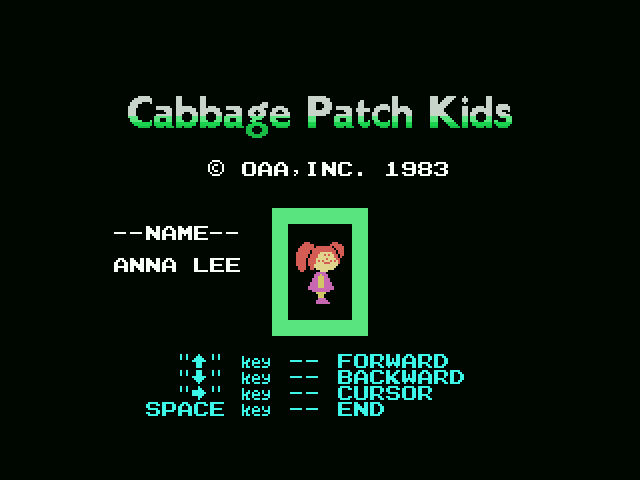
With two players the screen comes round twice: 0x426B sees the fire key, and
if bit 5 of 0xE002 says there are two, it changes turn and sets the menu step
back to 1 so the other player names theirs.
138 bytes of code that look like data
The dispatcher never returns to its call, so whatever has to run after a
state is pushed on the stack beforehand. Miss that and two whole routines —the
label blink and the menu's key reading— are never reached by the tracer and
come out of the listing as if they were a data blob.
The evidence is a single instruction: ld hl,04735h / ld hl,040c1h at 0x4131
and 0x4136, and the push hl at 0x4140.
The 256 bytes that were asked for as 24
The mirrored copy counts with B. The call at 0x6CD1 loads ld bc,0x0018,
which puts 0x18 in C and leaves B at zero, and a djnz from zero goes
round 256 times. So that copy carries 256 bytes into the pattern table, of
which the middle is then overwritten by the two copies that follow: what is
left showing of it are the two ends.
No hidden mark
Many Konami cartridges hide their catalogue number and the title in katakana
behind the filler at the end of the ROM. The format —title backwards, its
length, the last two digits of the RC in BCD and an 0xAA— was found by
Manuel Pazos
(@ManuelPazosMSX),
and it is thanks to him that anyone knows to look there.
This cartridge does not have it: tools/marca_konami.py finds no 0xAA
closing anything, and what is at the end is sound-player data. RC-716 comes
from the catalogue, not from the binary.
And the title says who the licence belongs to
The title screen reads © OAA,INC. 1983 — Original Appalachian Artworks, who
own the Cabbage Patch Kids — while the play screen reads ©KONAMI 1984. Two
different years and two different owners, on two different screens, both
written in the same font.
Open questions
What is settled, and what is not, kept apart. What is measured carries its measurement; what is assumed says so and has not been written into the listing as if it were a fact.
MEASURED, and closed
- The whole cartridge: 16,384 bytes, 16,384 explained, zero unexplained.
- The listing reassembles byte for byte with pasmo.
- 143 data ranges declared, all crossed against the trace, and every one of them either walked with the format its own consumer uses —the run-length unpacker, the label engine, the tile lists— or pointed at by an instruction that reads it.
- Commented at 24.5%, with no routine below 10% out of 562.
- The three leftover blocks from the other cartridge are identical byte for byte and have no reference at all: not an immediate, not a word inside any table.
ASSUMED, and labelled as such
- That the two bytes of the kid-picking screen choose its look. What is
measured is that
0xE05Band0xE05Care a row and a column each, that0x78C9places five sprites from them, and that the screen offers exactly the four actions0x79BAproduces. Which pieces of the kid change with each one has not been read off one by one. - The names of some obstacles. The engine is Athletic Land's and its annotations came across with it, so a few of them are named for what they do there. The artwork here is different, and the names of the objects have been softened wherever the drawing was not checked.
OPEN: what could not be settled
1. Whether the three leftover blocks were ever meant to be used
They are complete and well formed —the lists close on their own 0x00 exactly where the ones that are used begin— but nothing reads them. Whether the recompilation simply carried them along or something in an earlier build did use them cannot be told from this binary.
2. What the demo does, and how it decides
The attract mode plays on its own from state 7, and the states around it (18 and 19) belong to it, but the routine that feeds it its moves has not been picked apart.
3. The six streams of the table at 0x55F5
They are six run-length streams of 96 bytes of VRAM each, one chosen by the
high nibble of 0xE05B, and they go into the sprite pattern table. That
much closes exactly. Which of them is which kid, and whether the choice on the
first screen is what selects them, has not been checked on screen.
4. The blind jump at 0x408B
It is the dispatcher's own jp (hl), and its five tables are accounted for, so
nothing is missing from the trace. It is listed here because a blind jump is
always worth naming: if a sixth table existed, this is where it would come
from.