Findings
What turned up when we took it apart. Each one with its measurement.
Six opponents, three archives, and a hidden piece for the second round
There are six names, in a table of six pointers (0x5661). The figures come from another table, the one at 0x52C9, and that one has three words: 0x825C, 0x9670 and 0xABB4, the tables of figure archives 2, 3 and 4. 0x4F8D indexes it with (0xE207) & 3, and a fourth word would fall at 0x52CF, which is already code. It is never read: 0x423B forces the jump to the next group of sixteen as soon as the index reaches 2.
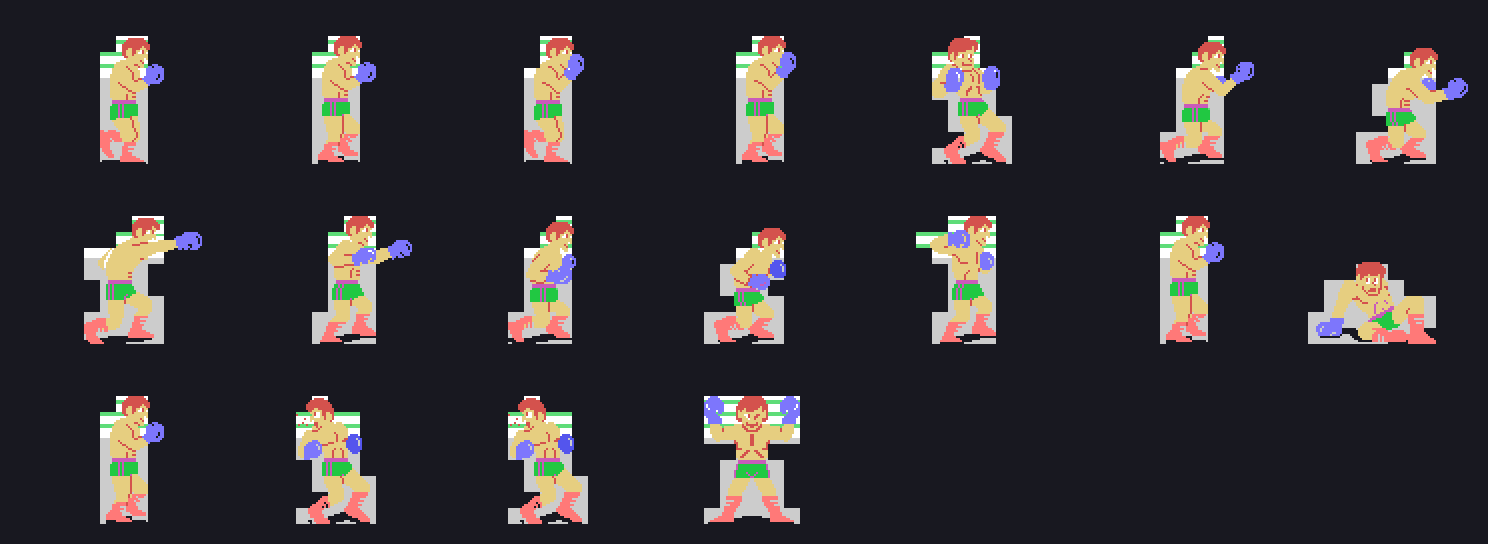
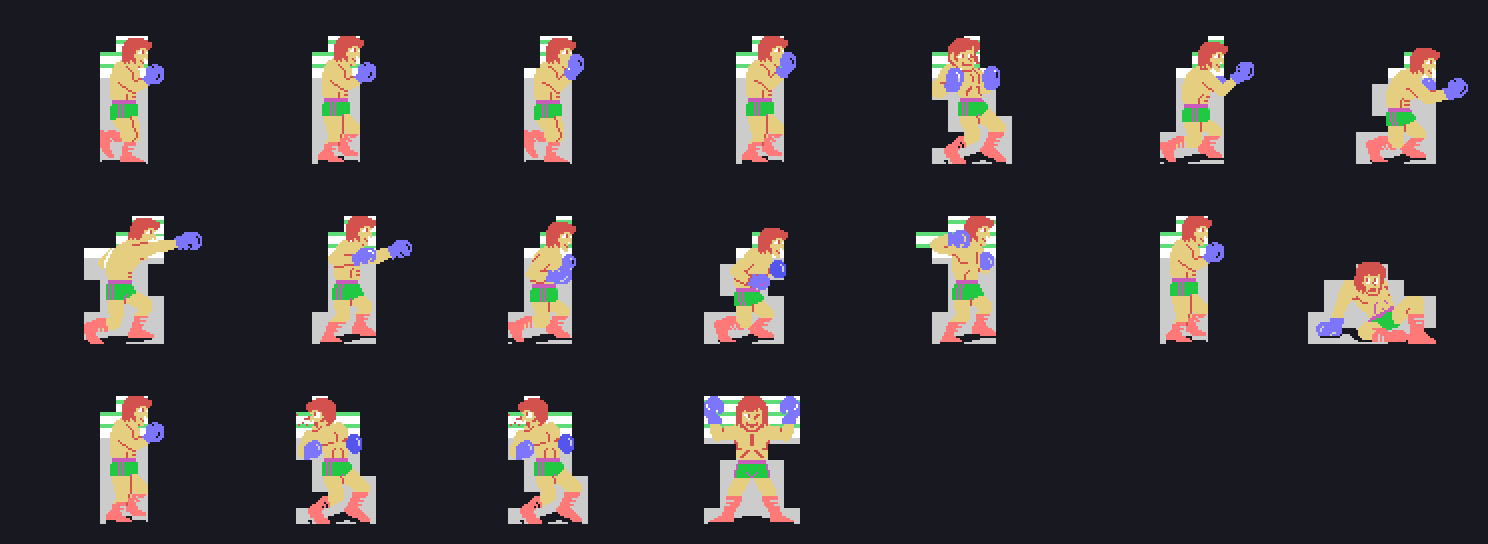
And yet the six look different, and SANCHESS is not RED WOLF in another colour. Every figure in the three opponent archives carries one piece more than its header declares: the byte at +8 says N, but 0x5005 does an inc b on the opponent's turn —bit 1 of the frame counter— and walks N+1 records and N+1 pointers. The first one is the piece of the second round, and 0x5034 (for the patterns) and 0x5187 (for the sprite attributes) decide what to do with it by looking at (0xE207):
| (0xE207) | opponent | what 0x5034 does with the first piece |
|---|---|---|
| bit 4 clear | RED WOLF, M.B.ALLI, MOAI KING | skips it (0x5048) |
| bit 4 set, bit 0 clear | SANCHESS, MOAI Jr. | paints it instead of the second (ld a,002h, 0x5040) |
| bit 4 and bit 0 set | CHINA KHAN | paints all of them (inc b, 0x5045) |
So SANCHESS wears RED WOLF's body with another head: the hidden piece of archive 2 (0x9558) is the same face with the hair down to the neck, where 0x856E keeps it short. CHINA KHAN is M.B.ALLI plus a black sprite (0xAB2E, colour 1): the pigtail hanging from his head. And MOAI Jr. swaps MOAI KING's empty sprite (0xBF7B, colour 0) for seven black pixels on the face (0xBF7D), and on top of that changes colour: 0x526F and 0x51BE turn colour 4 into 0x0C —dark blue into dark green— only when (0xE207) & 3 is 2 and bit 4 is set. The moai is the only one that changes colour.
None of this is a reading of the code alone. The VRAM of the six rings, dumped from openMSX with each opponent forced into (0xE207), comes out with zero differences in the twelve sprite attributes, in the pattern bytes of every sprite on screen and in the body tiles of both boxers (In the emulator).
Throwing a punch tires you
When a punch ends, acaba_el_golpe (0x49BC) adds to whoever threw it what the table at 0x6854 says, and the result goes onto his own damage:
| punch | hurts the other (0x6850) | tires the thrower (0x6854) |
|---|---|---|
| 5 | 12 | 3 |
| 6 | 10 | 2 |
| 7 | 9 | 1 |
| 8 | 2 | 1 |
Both tables run in the same order: the punch that hurts most is also the one that tires most. And above level 7 it stops rising: cp 007h at 0x49E4.
The punch only lands on the seventh and eighth frame
0x49FB loads 0xC0 into (0xE24C) or (0xE24D), and pega_el_de_la_derecha (0x4CCF) spends it with one srl per frame, bailing out with ret nc while there is no carry. Out of 0xC0, carry only comes on the seventh and eighth turn. Outside that window the punch cannot land.
The scorecard is kept upside down
(0xE21E) and (0xE21F) are the judges' cards, and they do not add up points: they add up faults.
- one if a boxer carries three levels or more of damage than the other;
- one to whoever landed fewer punches;
- and twice whatever (0xE23E) or (0xE261) says.
At the end, 0x4ECD does 10 - faults on both and then raises them together until one reaches ten. It is the ten-point must system of real boxing.
The machine plays the left-hand boxer
With a single player, the left-hand boxer is driven by decide_la_maquina (0x4A6B) and the human is the one on the right, the one wired to port 1 and the cursor keys. Three independent things say so:
- when they are placed (0x49FE), the one at 0xE232 gets column 22 and the one at 0xE255 column 2;
- when walking, the one at 0xE255 closes in by adding and the one at 0xE232 by subtracting, and the column limits are 22 above for one and 2 below for the other;
- the machine closes in walking right (0x4A83) and backs off to the left (0x4B39), which is what the left-hand corner calls for.
In scene 2 —the attract match— the right-hand boxer is driven by the Z80's R register (0x4836): both of them play on their own.
The machine returns the action in B with a bonus number in the high nibble, and that number is added to (0xE254) while it walks. (0xE254) is what later picks the punch script at 0x4C1C: the more it walks, the more what it is about to do changes.
The eight bytes nobody was reading
A figure's header is 17 + 5N long. Of that, the eight bytes 0x500C skips with a ld a,008h —the ones at figure + 9 + 3N— are the layout: one per row, the high nibble saying how far right to shift and the low one how many tiles run together. From 8 upwards, that row is not drawn.
With them the figure places itself, and the proof is not that it looks right: the name table that comes out matches the emulator's byte for byte.
The sixth opponent is called MOAI Jr.
Tile 0x58 is not the ASCII X. Drawing the font shows it is a glyph with the "r" and the full stop joined, so the name 04 4D 4F 41 49 51 4A 58 reads MOAI·Jr. —MOAI·KING's son, with whom he shares figure archive 4, which is a moai.

The backdrop is not the one in the boot table
R7 = 0xE4 comes from the eight registers at 0x4429, and it says the border is blue. But monta_una_columna_del_fondo (0x439E) writes 0xE1 into R7 on every call, and from the intro onwards the backdrop is black. It showed up against the emulator: building the screen with the blue from the table leaves it a different colour.
Code nobody calls
Three stretches that are valid instructions, fit between the routines either side of them, and that no call, no jp and no word of any table reaches —checked by searching for the two bytes across the whole ROM:
- 0x4038, which leaves the VDP data port in C, the same as the tail of
prepara_la_escritura; - 0x45CA, a sibling of
descomprime_en_tres_bancosthat usesvuelca_en_la_vraminstead of the decompressor; - 0x54EC, an alternative entry to the piece painter.
And one more that does run and does nothing: 0x470D writes to 0x4F84, which is ROM.