What the cartridge draws
Under each picture is where it comes from and what is on it.
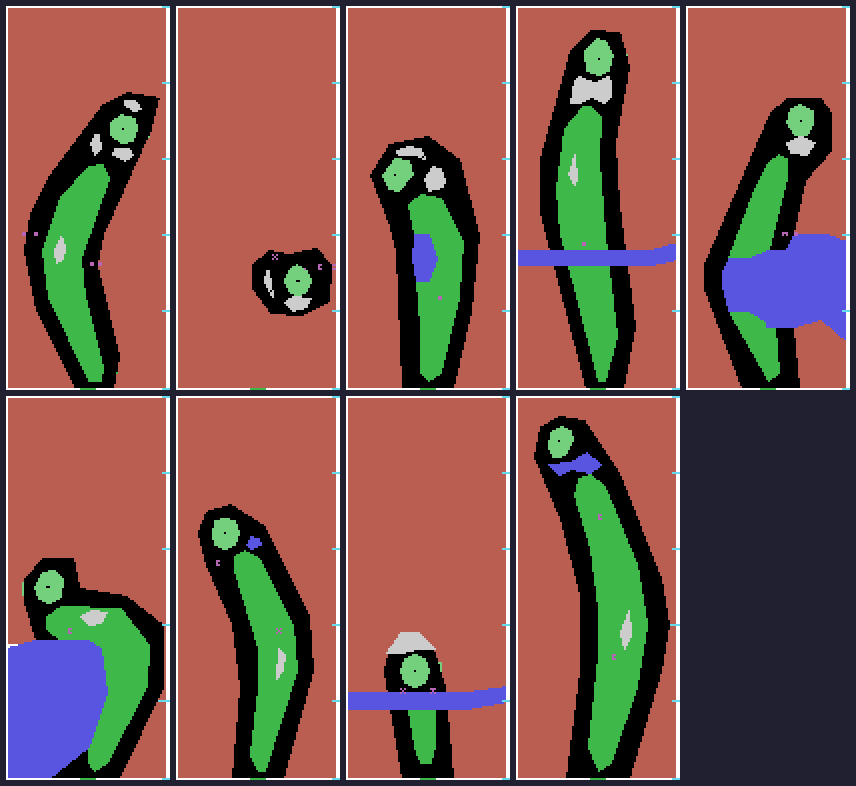
The course's nine holes, drawn one by one with the same subroutine 4000 the interpreter runs, from the 4,000 bytes of coordinates that begin at 0xB000. Red is out of bounds, black the rough, green the fairway, light green the green with the hole in it, grey the bunkers and blue the water
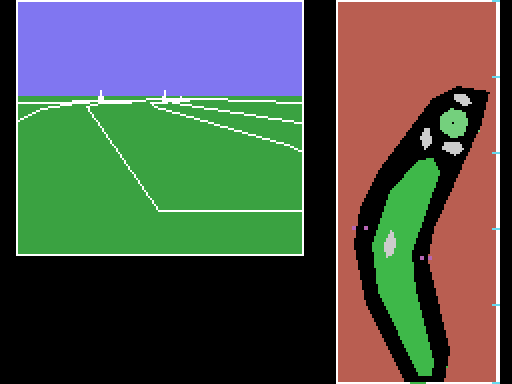
Hole 1's full screen exactly as it stands at the start: the perspective view on the left, the plan on the right. This is the image compared against the emulator's VRAM — 15,737 of 15,744 pixels identical on the plan, which is the one the game reads with POINT. The gap at the bottom left is the panel, written with the machine's font and not with cartridge data
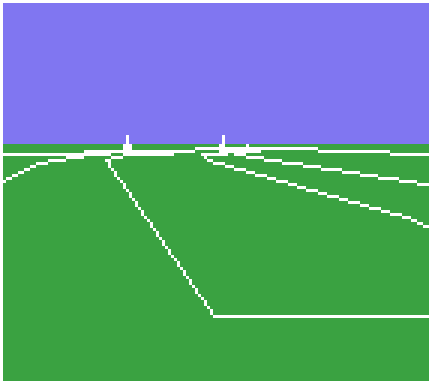
Hole 1's tee view. It is all wireframe segments translated by the camera, rotated with a matrix that turns on one axis only, clipped against the four walls of the view frustum and projected by dividing by the depth. The two lines running off to the horizon are not on the plan: they are stretches that begin after the 30006 marker

Hole 2, a 155-metre par 3: the only one with no fairway. Its data goes straight from the outer outline to the green, without the colour-2 marker the other eight carry

Hole 5, with the lake crossing the course from side to side. The blue spills to the frame because the water polygon reaches the edge of the course: the interpreter's fill stops at the border colour, and there is none there

Hole 9, the longest: par 5 and 482 metres, and the one that takes the most bytes of the nine (474)
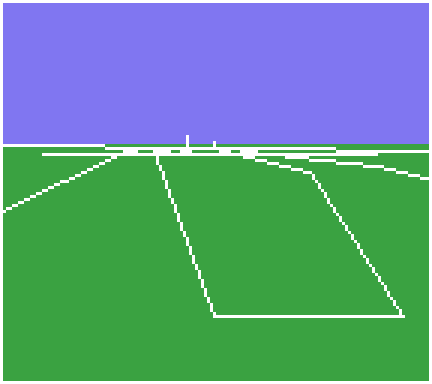
The tee at hole 4, a 441-metre par 5. The further away a point is, the closer together it comes out: the perspective is a division by the depth and nothing else
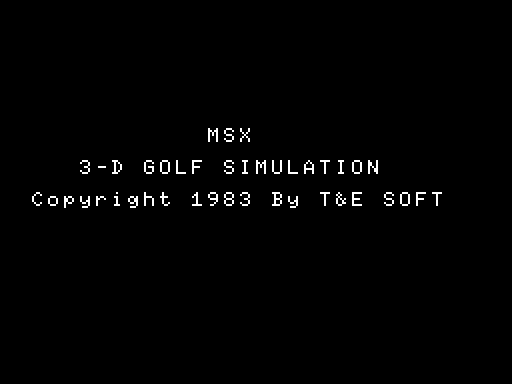
The title screen. This is the only image that does not come wholly from the cartridge, and it cannot: the position and the text come from the program (lines 2 and 3, three LOCATEs and three PRINTs), but the letters are drawn by the character set in the machine's ROM, which is not here. The shapes come from a VRAM dump of the emulator